
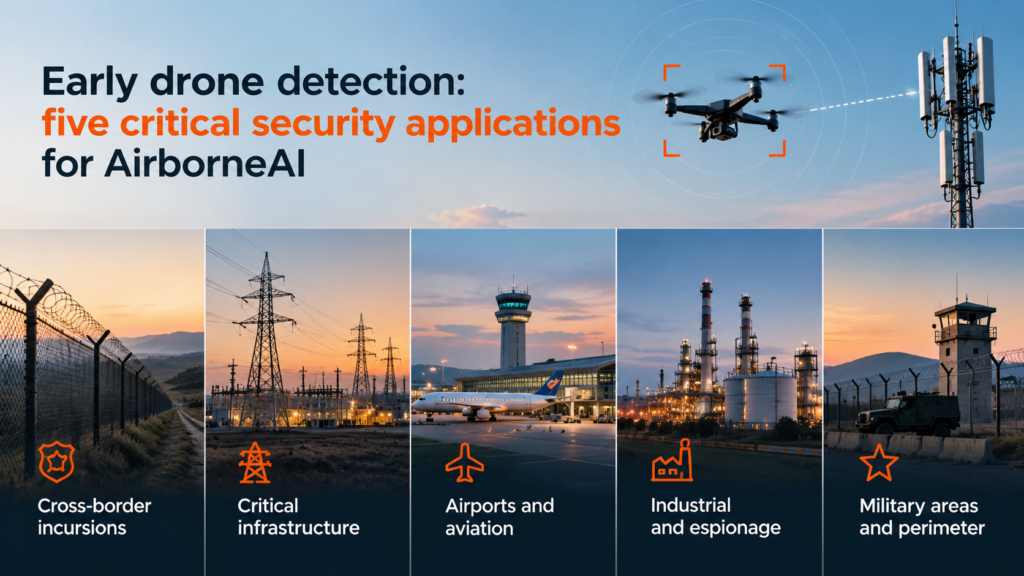
From national borders and military installations to airports, energy networks and industrial facilities, cellular-connected drones are creating new security challenges. AirborneAI enables early detection, localisation and characterisation of these threats by turning existing mobile networks into a wide-area drone detection infrastructure.
Why early drone detection is becoming a national security priority
The growing availability of drones is fundamentally changing how organisations approach airspace security. Small, relatively inexpensive aircraft can be used for unauthorised surveillance, smuggling, intelligence gathering and attacks against critical infrastructure.
The challenge becomes particularly complex when drones use cellular networks for communication.
Unlike conventional drones relying on direct radio-control links, cellular-connected aircraft can communicate through existing 4G and 5G infrastructure. Their operators may be located far from the aircraft, while their communications blend into ordinary mobile network traffic, making them difficult to identify through conventional RF detection systems.
This creates a fundamental security challenge: a threat can emerge almost anywhere, at any time, while the infrastructure needed to operate it is already in place.
Traditional counter-UAS systems, including radar, conventional RF sensors, cameras and acoustic detection, remain essential. However, these technologies typically provide coverage around individual protected locations and have limitations when applied to continuous, large-scale surveillance.
Dimetor’s AirborneAI addresses the cellular detection gap by analysing telecommunications network data to detect, localise and characterise cellular-connected airborne devices. Rather than requiring a new nationwide network of physical sensors, AirborneAI uses existing mobile network infrastructure as a distributed, software-based detection layer.
Early detection provides security organisations with more time to assess potential threats, distinguish authorised from non-cooperative drones and coordinate appropriate responses.
The following five applications demonstrate where this capability can deliver significant operational value.
1. Cross-border incursions: Detecting threats before they reach their targets
National borders present a particularly challenging environment for drone detection. Long stretches of remote terrain, forests, agricultural areas and transport corridors make continuous monitoring difficult using conventional point-based surveillance systems.
Drones can be used to transport illegal goods, conduct reconnaissance of border security infrastructure or enter restricted national airspace without authorisation.
Cellular connectivity introduces an additional complication. Operators may control drones from locations far beyond the immediate border area, making traditional methods of identifying nearby pilots less effective.
How early detection helps
AirborneAI can provide security forces with earlier visibility into cellular-connected drones approaching or operating near border regions, supporting faster identification, tracking and threat assessment.
This additional warning time can help authorities respond to suspected smuggling operations involving weapons, narcotics or other contraband before the aircraft reaches its intended destination.
It can also support the detection of unauthorised aerial surveillance targeting border patrol activities, checkpoints and other sensitive security operations.
By extending detection beyond individual checkpoints, cellular intelligence contributes to broader situational awareness across extensive border regions.
2. Critical infrastructure: Protecting thousands of distributed assets
Critical national infrastructure extends far beyond a small number of heavily protected strategic sites.
Electricity distribution networks, substations, water treatment facilities, telecommunications infrastructure and other essential services comprise thousands of assets distributed across entire countries.
Protecting each location with dedicated radar, optical or conventional RF detection equipment is operationally complex and expensive. Even extensive point-based protection can leave significant gaps between individual facilities.
Cellular-connected drones make this challenge more urgent because the communications infrastructure needed to operate them may already be available near these locations.
How early detection helps
AirborneAI enables cellular-based drone detection across large geographical areas, supporting the identification of suspicious airborne activity near critical infrastructure assets.
Earlier detection can help security teams assess and respond to potential sabotage attempts before a drone reaches vulnerable facilities such as electrical substations, power grids or water infrastructure.
It can also support the identification of unauthorised reconnaissance intended to gather intelligence about facility layouts, operational processes or physical security vulnerabilities.
The value extends beyond individual sites. Disruptions to essential utilities can affect entire communities, businesses and interconnected infrastructure systems.
For critical infrastructure operators, the objective is therefore not simply to detect drones at the perimeter, but to gain sufficient warning to protect essential services before an incident occurs.
3. Airports and aviation: Protecting restricted airspace and operational continuity
Airports are among the most sensitive environments for unauthorised drone activity.
Aircraft operating during takeoff and landing are particularly vulnerable to unexpected objects entering their flight paths. Even an unconfirmed drone sighting can require precautionary operational measures, potentially resulting in runway closures, diversions and significant disruption.
Traditional airport counter-UAS systems typically combine multiple sensor technologies, including radar, conventional RF detection and optical surveillance.
However, cellular-connected drones introduce an additional detection challenge because their communications may not resemble the dedicated radio-control signals monitored by conventional RF sensors.
How early detection helps
AirborneAI adds cellular network intelligence to existing airport surveillance systems, supporting earlier identification and localisation of cellular-connected drones approaching or operating within sensitive airspace.
This can give airport security teams and relevant authorities additional time to assess potential threats, coordinate responses and protect approach and departure corridors.
Earlier and more reliable detection can also support better operational decisions, helping reduce unnecessary disruptions while maintaining aviation safety.
The objective is to improve both flight safety and operational continuity, reducing the risk of collisions, emergency runway closures, diverted aircraft and costly delays.
4. Industrial facilities and espionage: Protecting intellectual property and hazardous sites
Industrial security involves more than preventing physical attacks.
Manufacturing facilities, research centres, chemical plants and other industrial locations may contain commercially sensitive information, proprietary technologies and processes that competitors or hostile actors could seek to observe.
Small drones equipped with cameras can potentially conduct unauthorised aerial surveillance of prototypes, production lines, facility layouts or restricted operational areas.
At hazardous industrial sites, the consequences of unauthorised drone activity may also extend to physical safety. A collision or deliberate attack involving sensitive equipment, chemical storage or processing facilities could create serious operational and environmental risks.
How early detection helps
AirborneAI can support the detection of cellular-connected drones operating near industrial sites, providing security teams with additional awareness of potentially unauthorised aerial activity.
This can help organisations identify suspected corporate espionage, protect sensitive manufacturing processes and reduce exposure of proprietary assets to aerial reconnaissance.
For refineries, chemical plants and other hazardous facilities, early warning also supports preventive security measures before a drone reaches safety-critical areas.
Integrating cellular intelligence with existing site security and counter-UAS systems strengthens both physical protection and the safeguarding of commercially sensitive information.
5. Military areas and perimeter protection: Detecting reconnaissance and hostile drones
Modern military installations face an evolving combination of aerial threats, ranging from unauthorised reconnaissance to weaponised and one-way attack drones.
The increasing use of cellular communication technology in military drone operations represents a significant shift in the threat landscape.
Historically, military surveillance and electronic warfare systems have focused heavily on dedicated military communications and identifiable radio-frequency emissions.
Today, some military drones can exploit ordinary civilian mobile networks for communication. This means potentially hostile aircraft may operate using the same infrastructure that supports millions of legitimate civilian devices.
Military threats can therefore exploit civilian communications infrastructure, requiring defence organisations to incorporate intelligence from those networks into their detection capabilities.
How early detection helps
AirborneAI provides an additional detection layer for identifying and localising cellular-connected drones operating near military installations, training grounds and other sensitive defence facilities.
Early warning can help security forces assess potential weaponised drone threats and coordinate defensive responses before an aircraft reaches protected assets or personnel.
It also supports operational security by helping identify suspected aerial reconnaissance targeting troop movements, equipment storage, base layouts and other sensitive activities.
When integrated with radar, conventional RF detection, optical surveillance and military counter-UAS systems, cellular intelligence contributes to a more comprehensive operational picture.
For defence organisations, the ability to detect threats exploiting civilian mobile networks is becoming an increasingly important element of layered airspace protection.
Beyond detection: Distinguishing friends, foes and fools (unintended airspace users)
As cellular connectivity becomes more widely adopted for legitimate drone operations, identifying an airborne cellular device will not automatically indicate a security threat.
Police drones, emergency response aircraft, infrastructure inspection platforms and commercial BVLOS operations may all use 4G and 5G networks.
At the same time, airborne cellular signals may originate from devices that are not drones at all, such as mobile phones carried aboard conventional aircraft.
This creates three essential categories for airspace security:
- Friends: Registered, authorised and cooperative drones, such as police or emergency response aircraft.
- Foes: Unauthorised, non-cooperative or potentially hostile drones that may present a security threat.
- Fools (unintended airspace users): Unintended airborne cellular devices or accidental airspace users, such as a passenger’s mobile phone aboard an aircraft.
Effective detection therefore requires more than recognising an airborne signal. Security systems must help determine whether a drone is present, where it is located, where it is heading and whether it is authorised to operate in that airspace.
AirborneAI contributes cellular network intelligence to this assessment, while integration with registration, authorisation and other surveillance data can support more reliable classification and reduce false alarms.
Why cellular intelligence belongs in multi-sensor counter-UAS systems
No single technology can detect every drone under all operating conditions.
Radar, conventional RF detection, electro-optical and infrared sensors, and acoustic systems each provide important capabilities, but they also have inherent limitations.
Cellular-connected drones create a particularly challenging gap because their communications can be embedded within ordinary mobile network traffic, making them difficult to identify through traditional RF monitoring alone.
AirborneAI addresses this challenge by adding a complementary, software-based cellular detection layer.
Its ability to leverage existing telecommunications infrastructure makes it particularly relevant for wide-area applications where deploying dedicated sensors across every potential target location would be impractical.
Integrating cellular intelligence with conventional counter-UAS technologies supports more comprehensive detection, localisation, classification and situational awareness.
From protecting individual sites to protecting entire regions
The five application examples share one fundamental requirement: security organisations need to detect potential drone threats early enough to act, not simply identify them once they have reached a protected perimeter.
For border security, that means detecting suspicious activity before an incursion develops. For critical infrastructure, it means protecting geographically dispersed assets. For airports, it means safeguarding flight operations. For industrial facilities, it means preventing espionage and physical disruption. For military installations, it means identifying hostile activity before it threatens personnel, equipment or operational security.
Cellular-connected drones make this challenge more complex because they can exploit communications infrastructure that is already widely deployed and conventional RF scanners are not able to identify signals within the already busy cellular spectrum.
AirborneAI turns that same infrastructure into an additional source of drone detection intelligence, supporting scalable, wide-area situational awareness for civilian and defence applications.
As drone threats become more geographically distributed and increasingly difficult to detect, national airspace protection must move beyond isolated point-based systems towards integrated, continuous and wide-area detection.
Learn more about AirborneAI and Dimetor’s airspace intelligence solutions.